
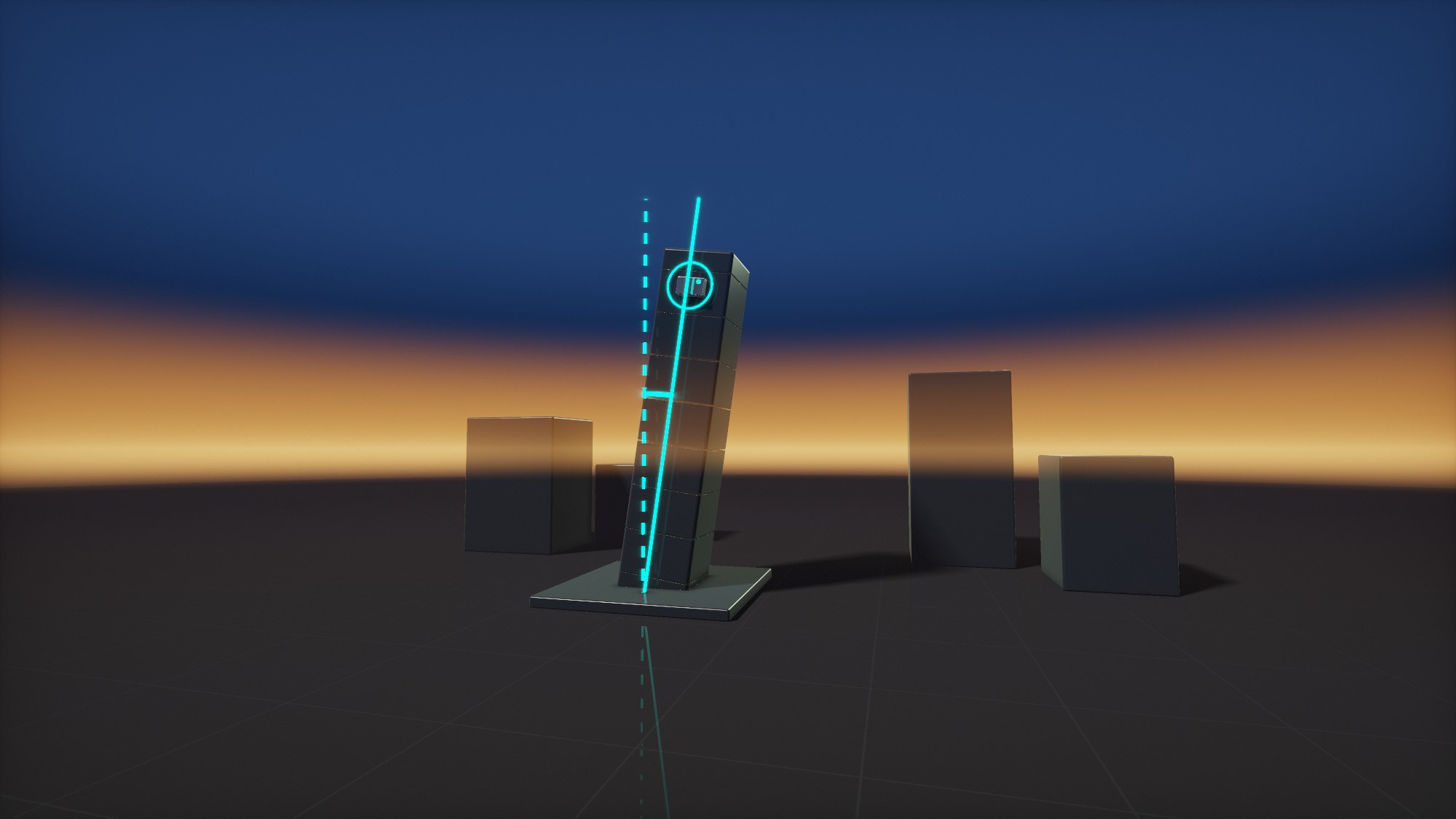
Small angles, big consequences
Structures settle, cranes and booms must stay within limits, solar trackers and antennas must point correctly. Tilt sensors measure the direction of gravity and turn it into inclination angles, continuously and without moving parts.
AMCORIS supplies Epson accelerometers and IMUs for inclination monitoring and supports you from sensor selection and evaluation to integration.
QUICK ANSWER
How precisely can an accelerometer measure tilt?
Tilt is calculated from the gravity component on each axis. Near level, 1 µg of acceleration corresponds to about 1 µrad (0.00006°) of tilt, so a low-noise sensor such as the M-A352AD10 with 0.2 µg/√Hz resolves extremely small angle changes. Long-term accuracy depends on temperature stability and a rigid mounting.
Typical applications
01
Bridges and tunnels
02
Buildings and towers
03
Railway track and switches
04
Cranes and booms
05
Solar trackers
06
Antenna alignment
07
Construction machinery
08
Structural health monitoring →
FROM GRAVITY TO ANGLE
How an accelerometer measures tilt
At rest, an accelerometer measures gravity. When the sensor tilts, gravity is distributed differently across its axes, and the tilt angles follow directly from these components.
1
Sense
Three-axis acceleration, dominated by gravity when the object is at rest.
2
Calculate
Tilt angles from the gravity components; the M-A552 outputs them directly.
3
Filter
Averaging suppresses vibration; the bandwidth is chosen per application.
4
Monitor
Changes are tracked over time and alarms raised when limits are exceeded.
Noise density in µg/√Hz. Shorter is better.
M-A552AR10 / M-A552AC10
M-A352AD10
M-A370AD10 (measured by INGV)
Sources: Epson data sheets M-A352AD10, M-A552AR1 and M-A552AC1x; Patanè et al., Sensors 2026, 26, 5528.

SENSOR SELECTION
Which Epson sensor for which tilt task
Three-axis accelerometers with digital interfaces for static inclination, plus IMUs for platforms that move while they tilt.
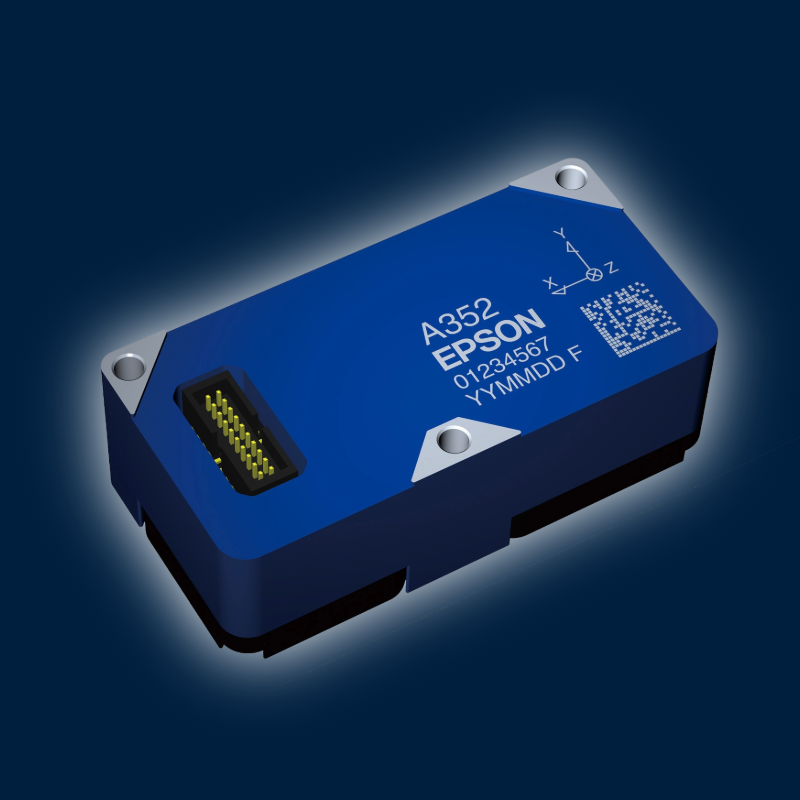
M-A352AD10Available online
Accelerometer · UART/SPI · 0.2 µg/√Hz
High-resolution tilt on structures and precision equipment.
Buy now →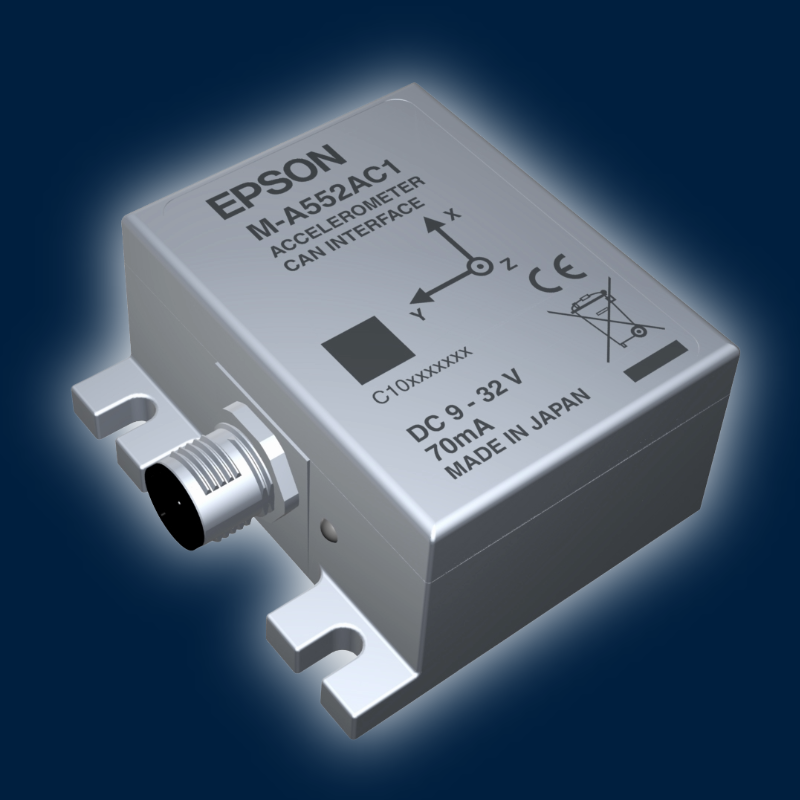
M-A552AR10On request
Accelerometer · RS-422 · tilt output · IP67
Outdoor structures, cranes and long cable runs.
Product details →M-A552AC10On request
Accelerometer · CANopen · tilt output · IP67
Machines and vehicles on a CAN bus.
Product details →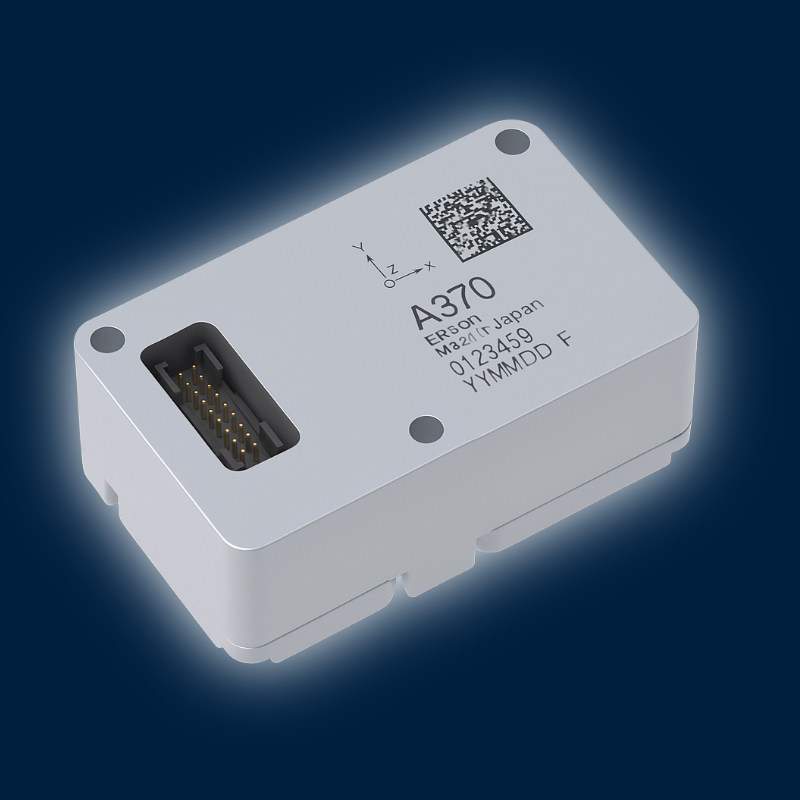
M-A370AD10On request
Accelerometer · UART/SPI · ultra-low noise
Very small angle changes on sensitive structures.
Product details →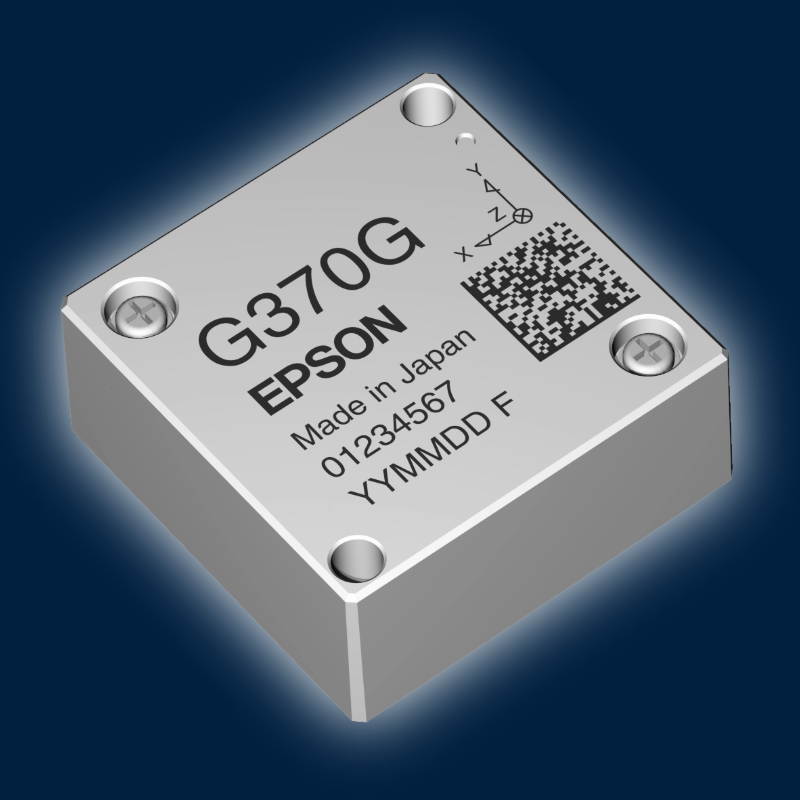
M-G370PDGOn request
IMU · UART/SPI · 0.8 °/h · 0.06 °/√h
Tilt plus angular rate for platforms that move.
Product details →.png)
M-G552PJ7On request
IMU · J1939 · IP67 · 0.06 °/√h
Levelling of construction and agricultural machinery.
Product details →
WHY AMCORIS
Why engineers choose AMCORIS
01
Inclination expertise
Experience with structures, machines and tracking systems.
02
Low-noise accelerometers
Noise density down to 0.2 µg/√Hz (M-A352AD10).
03
Tilt output built in
The M-A552 series outputs tilt angles directly.
04
Application engineering
Sensor selection, evaluation kits and integration support.
QAccelerometer, inclinometer or IMU?
For static or slow tilt, a low-noise accelerometer is the most precise choice. If the object moves or vibrates strongly while tilting, an IMU adds gyroscopes that separate rotation from acceleration.
QHow does vibration affect tilt measurement?
Vibration adds acceleration on top of gravity. Filtering and averaging remove it for static monitoring; for dynamic platforms an IMU gives the more reliable angle.
QWhich interface for outdoor installations?
The M-A552AR10 with RS-422 and the M-A552AC10 with CANopen are housed to IP67 and suit long cables and harsh environments.
QCan I test the sensors before ordering?
Yes. Request an Epson evaluation kit from AMCORIS. The M-A352AD10 can also be ordered directly in our online shop.
EVALUATION KIT
Test it in your own system
Epson evaluation kits are available from AMCORIS as a free loan for qualified projects. Share a few details about your application and we prepare the right kit and support you during the evaluation.
✓Free loan for qualified projects
✓Help with model selection and set-up
✓Direct line to our application engineers


