
News · Navigation
GNSS outages: why IMU error growth sets the limit
When satellite signals fail, the inertial sensor carries navigation, and its error budget decides for how long.
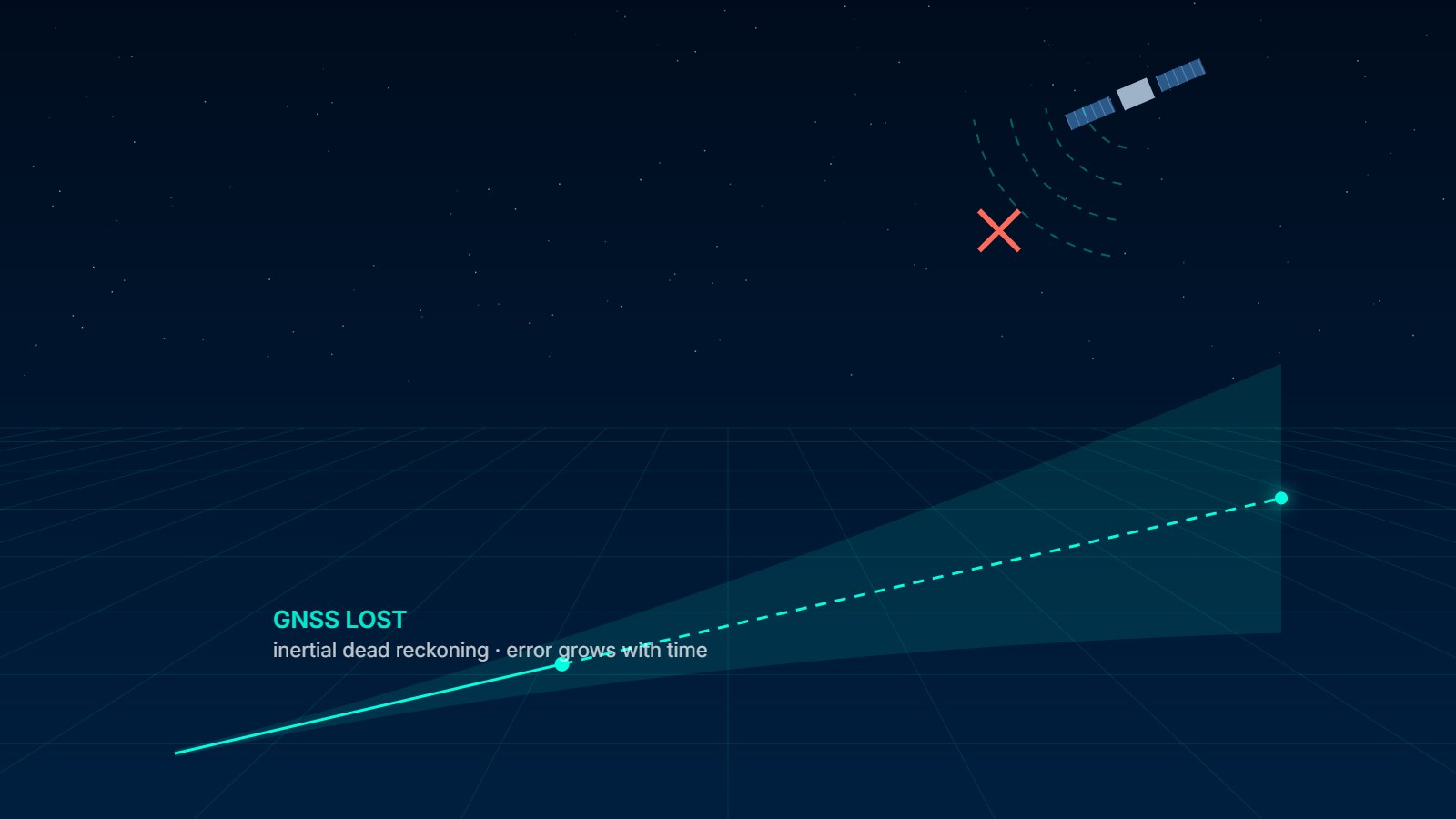
A Forbes article published on 27 October 2026 looks at navigation in GNSS-denied environments. It lists the usual causes: deliberate jamming, urban canyons, tunnels and caves, and underwater operation, where GNSS radio signals do not reach the receiver. Inertial measurement units keep working in all of these cases, but they accumulate errors and can only bridge an outage for a limited time.
Specify the IMU by its error growth
For system designers, the practical consequence is to specify the IMU by its error growth, not only by its measurement range. Gyro bias instability determines how quickly heading drifts; angle random walk sets the short-term noise floor.
Epson lists these values for the M-G370PDG (M-G370PDG0). For smaller platforms, the M-G366PDG and M-G330PDG share the same compact footprint.
Supply security as a selection criterion
The article also points to supply-chain security for navigation components as a growing selection criterion.
The drift calculator in our IMU Selection Guide shows how much candidate IMUs drift over time. For qualified projects, an evaluation kit is available as a free loan.
Source: Forbes, 27 October 2026. Values: Epson product page, typical.